Category Archives: Uncategorized

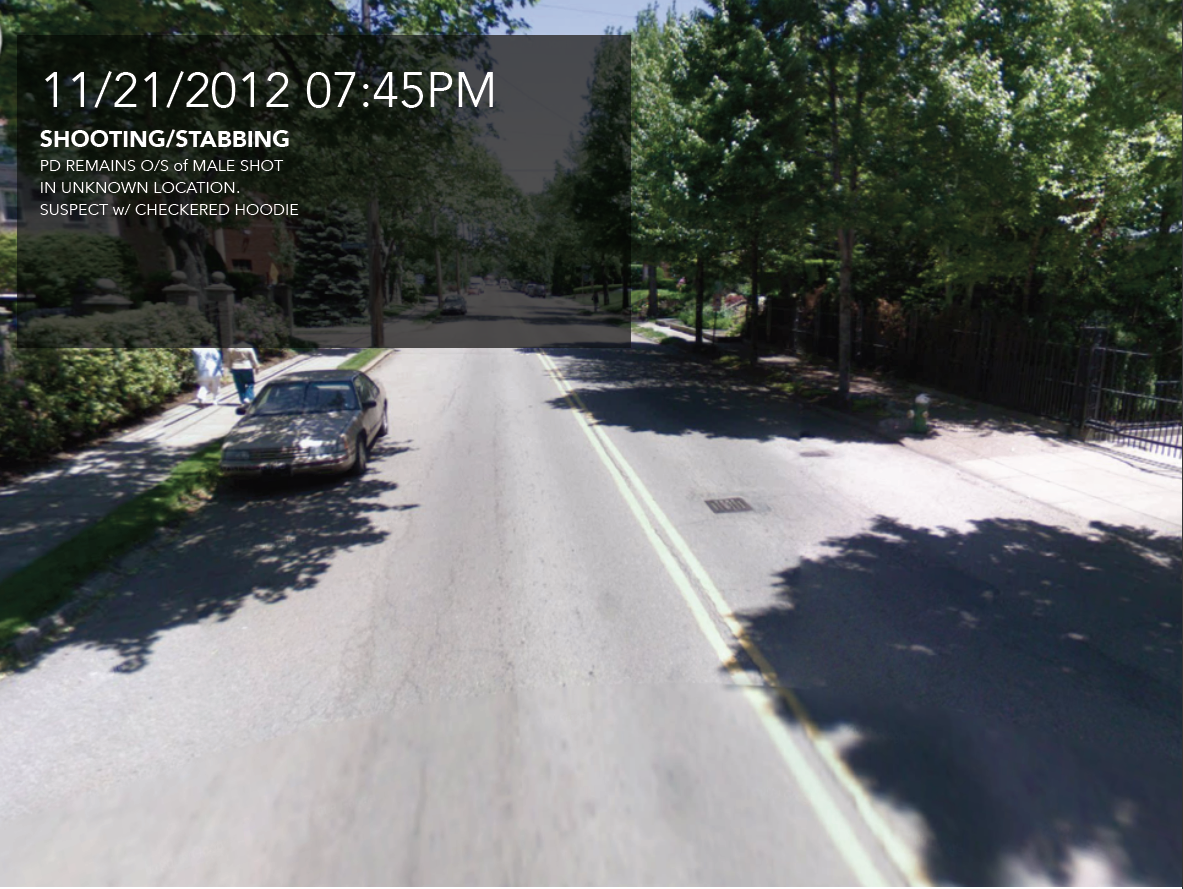
In Class Project with Danielle: If 6 People are shot 5 live (1 dies)

As we were discussing this statistic, we became interested in the idea of how it relates to time and how to get these individuals to relate to death and living as two things, each with serious consequences.

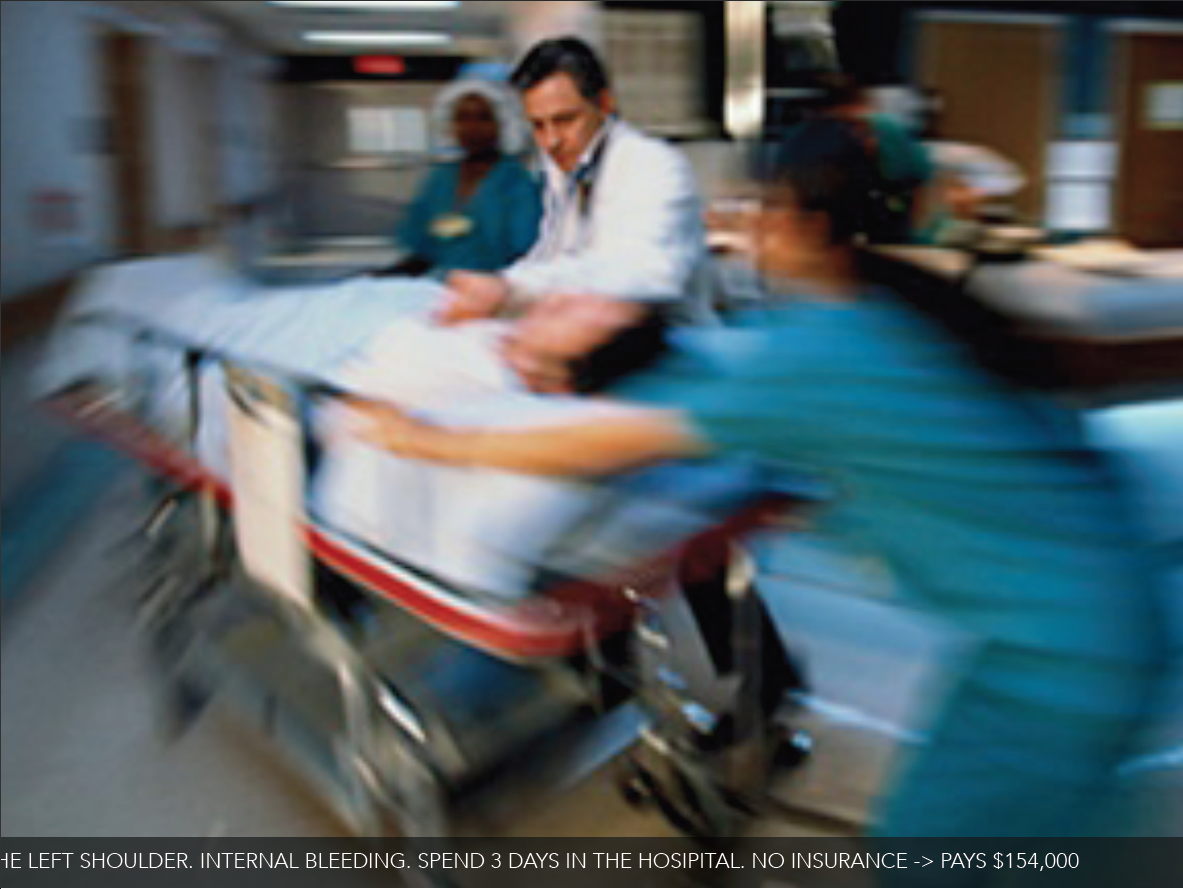
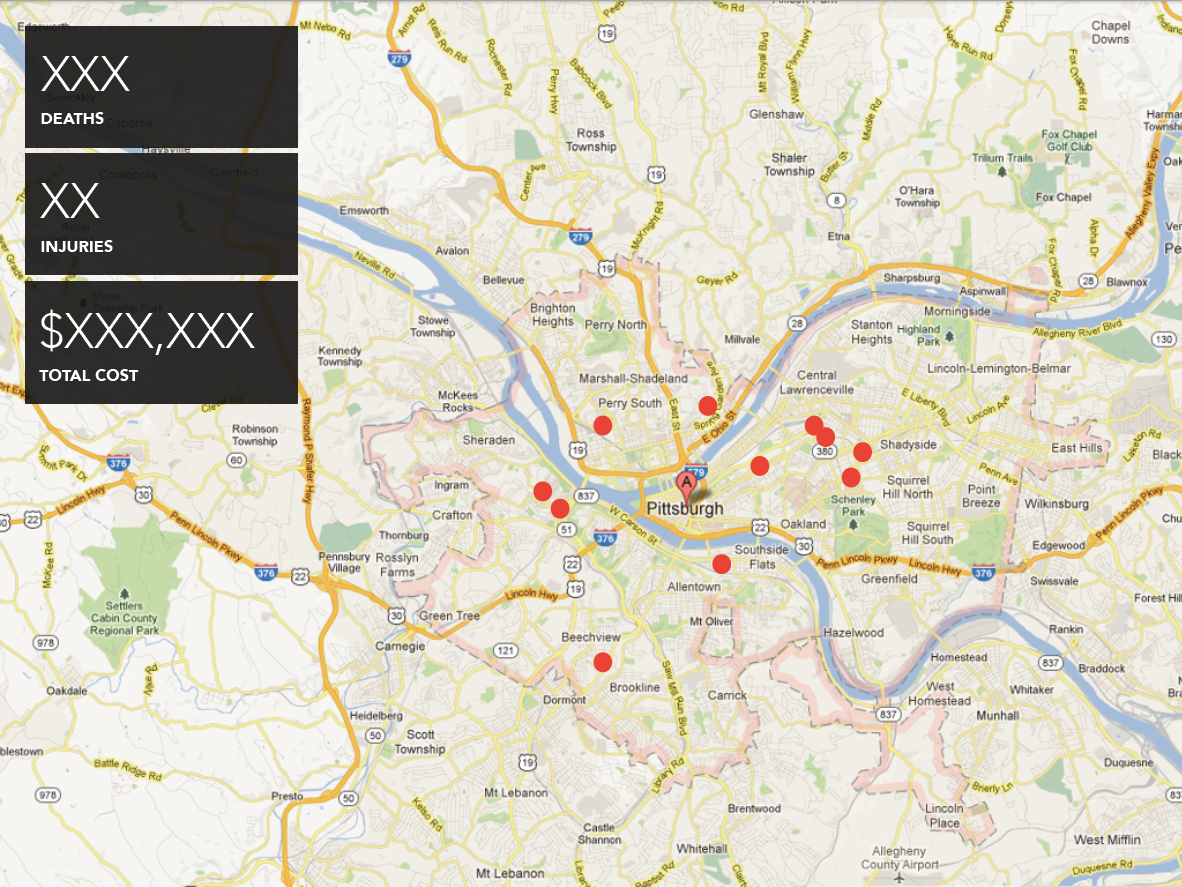
We also were inspired by http://spotcrime.com/pa/pittsburgh/daily where you can see these different crimes happen to a date, but when those locations are really related to a place, by a photo, how that changes how a person relates to it. We also became interested in communicating how the story continues, is it possible to show the hospital visit, the psychological issues, the funeral costs.

Screen Shot 2013-02-13 at 3.58.52 PM

Screen Shot 2013-02-13 at 3.59.03 PM

Screen Shot 2013-02-13 at 3.59.14 PM

Stats

1. Currently, one in four adults owns a gun of some kind, but owners of four or more guns (about 10 percent of the adult population) are in possession of 77 percent of the total U.S. stock of firearms (Cook and Ludwig 1996). 

Hemenway, David. Private Guns Public Health. Michigan: The University of Michigan Press, 2006. 6. Print.

2. The direct medical costs of gunshot wounds were estimated at six million dollars per day in the 1990s. The mean medical cost of a gunshot injury is about seventeen thousand dollars and would be higher except that the medical costs for deaths at the scene are low. Half of these costs are borne directly by U.S. taxpayers; gun injuries are the leading cause of uninsured hospital stays in the United States.

Hemenway, David. Private Guns Public Health. Michigan: The University of Michigan Press, 2006. 4. Print.

3. Living in a home where there are guns increases the risk of homicide by 40 to 170% and the risk of suicide by 90 to 460%.

Garen J. Wintemute, Guns, Fear, the Constitution, and the Public’s Health, 358 New England J. Med. 1421-1424 (April 3, 2008), at http://content.nejm.org/cgi/content/full/NEJMp0800859.

4. For every one person gets dies from gunshot, 5 survive.


5. Guns kept in the home are 43 times more likely to be used to kill someone known to the family than to be used to kill in self defense.

1. Kellermann AL,

2. Reay DT

(1986) Protection or peril? An analysis of firearm-related deaths in the home. N Engl J Med 314:1559-1560.

6. 4,166 children shot accidentally in 2010 in U.S. due to unsecured guns in the home

Centers for Disease Control, WISQARS 2012

The Problematic Narrative of Narrative

Ever since Laurene asked me last week to give a short presentation on narrative, I have been trying to come up with an adequate way to summarize in twenty minutes a topic that has consumed and conflicted my mind, heart and soul for as long as I can remember (and no, I’m not exaggerating). In order to give a successful presentation on narrative, it seems like one ought to have a story to tell about narrative – a meta-narrative, if you will. The problem is that I have several stories that I would like to share with you about narrative, and all seem equally important. I could, if I wanted to, focus my entire presentation on any of the following:

– the definition of narrative and its development over history
– a comparison of different narrative structures’ strengths and shortcomings
– narrative as a form of information organization and argumentation
– narrative’s place in art, design, business, the hard sciences, and other fields
– my personal experiences with narrative in the fields above
– the role of narrative in my current thesis project in patient-driven healthcare

Then, throw in the topic of this studio course: gun control & children, and one instantly receives a few more issues to address, and soapboxes upon which to stand:

– ways designers can effectively use narrative to articulate future (and present) scenarios about gun violence
– the responsibility of the artist to tackle difficult topics in fiction
– the irresponsibility of modern media when tackling those same topics
– symbolism, metaphor, and the representation of violence
– political narratives, legislature and censorship

I have limited the list to the above, primarily for the sake of my own sanity. Just pick one and talk about it, you say. Sure, perhaps I could. But I have a deep rooted fear—a fear that has been instilled within me by the complexity and sheer vastness of the modern world—that any one of the topics above lose their meaning without the influence of the others. What good is my blathering about personal experience without a concrete foundation on narrative theory? What good is the theory without some emotional human anecdote to bring it to life? Why would I discuss narrative as a neutral tool—one for art, or design, or science, treading quietly and politely, when all stories are political? But what purpose would I serve to illustrate the politics of plot without reminding you that all stories—all good stories—reach beyond ideological machinations and touch upon something deeper; a primal instinct that none of us can readily articulate?

This, I think, is the primary source of angst for modern society. For every topic these days, narrative included, there are a million and one perspectives, an onion’s worth of layers, a thousand contexts, and several dozen university departments’ expertise to consider. As Steve Almond wrote recently in a New York Times article about narrative: “The underlying and […] ominous question is whether the story of our species — the greater human narrative — has simply become too enormous, too confused and terrifying, for us to grapple with.”

The ironic thing about all this confusion and complexity is that it screams for a better narrator. If a person – be it a writer, a designer, an engineer, or a businessman – can grapple with the sheer quantity of perspectives available on a topic, select a suitably pressing one, and successfully tell a story with enough depth to establish expertise and enough breadth to securely situate an audience, it’s not an understatement to say that person is a strong contender for ‘master of the universe.’ After all, what I’ve described above could be described as narration, but could just as easily be described as building a world.

I try to be a good narrator – at very least I hope I’ve been passable in this blog post – but the truth is that I’m still wandering around the space of trying to figure out the most ‘suitably pressing’ story to tell. As a twenty-something with the heart of a novelist, the college degree of an engineer, and the skill set of a designer, I find that the ‘suitably pressing’ story shifts as I put on different hats. And at times, I’d rather take off all the hats and stop trying to make a point. But I press on in spite of myself, because every so often (and maybe somewhere in this post) I know I’m touching upon some fragment of enlightenment that I can pass on to other people: one brick in one building of that universe we need to construct.

One way to look at narrative in the setting of the modern world of wicked problems and global interconnectivity is exactly that: a conglomeration of small bricks of enlightenment. Maybe, as Almond suggested, the world is in fact too large for one narrator to tell the story we need to be telling ourselves. Maybe moving forward, we should learn to view narrative as a kind of crowd-sourcing of the ‘suitably pressing’. The internet and social media networks would already suggest this is the case. However, if all we ever manage to bring to the world-building exercise is a single brick, it would do us all a bit of good to step back, hone the story we’re telling, and make that one brick a damn good brick.

Tomorrow, I’ll try to talk a little bit about how one might go about honing a story. I’ll just pick a topic and talk about it—namely, the work I’m doing with narrative in the space of patient-centered healthcare. But hopefully this post will help to situatuate that one fragment of narrative in its own larger story.

Individual Project Brief 2.10.13

What will your individual exploration of the issues in this class focus on?

My individual exploration of the issues in this class will focus on personal responsibility and connectedness in the community of Pittsburgh. Potential impact of Child Access Protection will also be explored. Another issue that will be addressed is urban gun ownership v. suburban gun ownership in our community and the trafficking of weapons.


What is it that you want to know?

Something that I would like to know is if what I want to do for my individual project is appropriate? Or if it will make a big enough impact? I want to make something meaningful and beautiful to help people gain more understanding about the issues but I am not sure how I can make the most of my work, or I guess that is something I worry about. I don’t want to make something trivial. I guess another thing that I want to know is how to best portray the issue without villainizing or victimizing groups of people. I want to make sure that I am being sensitive to the issue while at the same time having impact.


What is it that you want to do?’

I want to tell a story about how all of us are connected within our community, even if it seems like a stretch. My audience in particular is the suburban and white middle and upper middle class of Pittsburgh and I hope to just raise consciousness around how their purchases and habits around guns can affect the lives of others.


What I want to do for the individual project is to:

Write a poem about there being two Pittsburgh’s that seem to not really be connected, but through the death of a mother in Homewood the reader finds out how we could all be connected to her and her death. Then there is a call to action and reflection about the guns in your home and how they are a part of the problem of violence in Homewood.


What will your reference material be for this? (readings, designers, writers etc.)

My reference material will definitely be what I have already read from Private Guns, Public Health. I also plan on talking to Vanessa German. I have been really inspired by her for my individual project because of her work in the community and the poetry that she writes and performs. This summer I had the chance to see her perform one of her poems and I was really moved by the complexity of the material she tackled and by how dramatic her performance was. I plan on talking to her and sharing what I am working on with her so that maybe I can get feedback from her and learn more about her work. I was also really inspired by the interview that I did earlier. I feel like the anecdotal story he shared was really powerful and I want to be able to tell a story that while fictional is able to make people feel that they need to take action. I will also maybe try to bring in some of the stats that Kerry and Vicky shared with us about stolen guns. There is also a Frontline special called “Hot Guns” about how guns are trafficked for violent crime that I think I want to use for research. Also maybe just taking more time to watch the local news for inspiration.


What will the material outcome be?

The material outcome will be the poem itself along with some other sort of visualization of the poem. I am not sure if I will make the poem into a poster (or series of posters) that use expressive typography to better communicate the poem, or if it will be told like a children’s story with illustrations. There could maybe even be a video montage of scenes of Pittsburgh that could go with a dramatic reading of the poem.


What is the scope of this investigation? How big will it be? How many components,

words, minutes?

The scope of the project is somewhat small. I will be a poem that takes maybe only about 5 minutes or less to read.  The components could be posters, a book, or video piece. Maybe if I have time I could do different renditions of it for different contexts.


What is your timeline for progress through this?

Well, I have already started to write the poem, and I am hoping that I can having it finished by feb 17th so that I can share it with a few people and see how they react to it. Once I finish writing I will have more of idea of what visual form the poem should take. I think that only once I am done with it will I know if it will be best as a poster, or book, or just performance piece to be shared by video, or by whoever wants to read it. Hopefully After Spring break I can share what I have with Vanessa German. By April I want to have the poem fully materialized in a way that it can be shared with all sorts of people.


How will you know that you are making progress on this?

I way I know I am making progress is through my ability to share this with others. Really being able to get my ideas out of my head and materialized in different ways would be the best way for me to know I am making progress.


How will you measure your success in realizing your ambition?

I think that I will measure my success through the reactions I get when I share it. I want to share the poem with different people and see their reactions before I make it something to be communicated more broadly. I have to say though that measuring my success when it comes to something like this is difficult. Maybe if what I make could be used to implore more lawmakers to support child access protection laws, while at the same time educating gun owners why they are necessary would make me feel successful in the project.  

Monday Feb 11

What a great week of refinement and clarification we had in the studio last week. We now have a clearer idea of what the issues are, of what we know and what we don’t.

What has become increasingly apparent is that although there is a lot of information available and still even more that isn’t, that even with all this, making sense of it, connecting to it, and realising what it means for individuals in everyday life, or for organasitations seeking to introduce a child protection law – is hard. Over the next few weeks we are going to be working on ways to make the data/information more meaningful.

To do this, students in the studio are going to go and speak to different people in the community who represent the many different people involved in the gun ecology of Pittsburgh. We are also going to explore ways to make the ‘data’ have more meaning or be more accessible to different members of the community. And finally, we are going to play with some design futuring to help us imagine future scenarios.

Where is all this leading us you may ask?

Through this process we are working toward the design and development of Strategic Briefing Publication that will help others who might want to design into this area, to identify and think about the many aspects that inform/influence this social phenomenon.

Design Fiction Ideas

After our conversation today I was really inspired by the idea that weapons can be concealed or not concealed.

What if guns were so normalized that everyone carried around guns? How would people today react to me, a 21 year old white girl, carrying a gun openly? What area or time of date would be safe for me to carry a gun openly? What makes it alright to carry a gun openly?

What if guns were liable? What if insurance increased for owning a gun or multiple guns? How much money would be saved in healthcare? Would the visible risk factor, make people not want to own a gun?