
During one of my Risk Perception and Communication classes, we discussed how different people see risks. One of the most interesting things I learned was that white men tend to see less risk in the world than white women or minority men and women. This is obviously relevant to risk communication because it’s necessary to know who your audience is in order to get them to understand a risk. I think it’s also pretty relevant to our projects – not everyone is going to be moved or called to action by the same story or statistics.
Category Archives: Uncategorized
Law Center to Prevent Gun Violence
smartgunlaws.org is the home of the Law Center to Prevent Gun Violence. I had a conversation with Danielle, Michelle, Jisoo, and Lena today, and we had questions about different policies that exist and the extent of the laws. I came across this organization and was surprised by how accessible all the information is. There are even a lot of celebrity endorsements for ending gun violence, from Jon Hamm to Beyoncé!
The LCPGV provides information on each of the state’s gun policies and has a special section for each Child Access Prevention Laws. I was also surprised that so many states have CAP Laws, especially notoriously pro-gun states like Texas. But, as Danielle postulated earlier, perhaps the residents of states where guns are more ingrained into daily life better understand the importance of gun safety. This is a great resource to have especially as we navigate the complicated world of policymaking.
Average Gun Owner
An article about a seemingly average gun owner. He considers himself liberal and votes almost entirely Democratic. He talks about his own motivations for owning a gun- while he recognizes the statistics that say that owning a gun puts him and his family at danger, it’s not what drives his decision. He remarks on the duality of the feeling of powerlessness in society versus the innate disposition for men to serve as protectors.
This article compares the safety of guns and the safety of consumer vehicles. It argues that they both have similar risks for injury and death, however, cars are more regulated because of impediments from the NRA. It discusses many facts learned from our previous readings, though it goes into more depth about gun control in states like Florida and how that affects gun death averages. It argues that we’ve made such strides in regulating other dangerous activities like driving that we can do the same for guns.
Bob Costas on Gun Culture in America
http://www.hulu.com/watch/450689#i1,p4,d1
This clip is from an interview Bob Costas did with Jon Stewart on The Daily Show. If you don’t know who Costas is, he’s a sportscaster for NBC who controversially addressed the issue of gun control during halftime of Sunday Night Football, shortly after Jovan Belcher (a Kansas City Chiefs player) shot his girlfriend, Kassandra Perkins, and then shot himself in the Chief’s training facility.
Costas and Stewart touch on the idea of the gun culture in America, mostly how it is driven by the hip-hop industry and culture, which many of the NFL’s players are strongly tied to. Both hip-hop artists and NFL players are idolized in the minds of many young American men. The clip is only 7 minutes, so it’s worth a listen.
Current representations of guns in pop culture
Something that I have been looking at is the most recent depictions of guns in pop culture. A movie that is coming out next month is os particular interest to me is “Spring Breakers”. Below is the link.
While it may be easy to turn up your nose to a movie like this, I think that it is has real cultural relevance.
reason#1 : The cast.
The cast of for this movie includes Selena Gomez and Vanessa Hudgens. Both products of the Disney machine and have had reached stardom through pandering to the tween crowd with “wholesome” family-type entertainment. In this movie they choose to shatter their “good-girl” images and are now gun-wielding, bikini-clad college co-eds at Spring break. By having these girls in the movie, the movie has more mainstream appeal and will be something that people will probably take the time to look at. The movie also had James Franco who also has real mainstream appeal. Franco plays a mix between K-Fed and Riff Raff, which in his depiction of the character also shows how this movie blurs the line between what is mainstream cultural consciousness (k-fed) and the fringe, art-house, and general out-there-ness of Riff-Raff. James Franco may be the perfect choice to embody both of these.
reason #2: springbreak
spring break is a cultural phenomena that is unique to the millennial generation. You have to have college to have spring break, so only now that college is a common cultural experience, can spring break be a common experience. The spring break depicted in this movie is dark of course, but not far fetched. the debauchery, law breaking, and constantly walking around with no clothing is part of spring break today, but something that is not is gun violence. this bring me to #3
Reason#3: Guns + spring break. So while participation in this sort of ‘gone-wild’ spring break does involve rule-breaking, guns have not really been seen as a part of spring break. Now they are. This movie opens up a new view into what spring break could be. A weird design fiction of everything that could possibly go wrong with spring break. The evolving presence of guns in public spaces in America could lead to this and relatively soon. While of course this is only a movie, it is meant to shock and entertain, it is just one more example of guns are becoming more and more present in places where guns do not belong.
Risk Perception and Psychology
Here’s an interesting article published right after the tragedy in Newtown, CT, from PBS about perceptions of risk: http://www.pbs.org/wgbh/nova/body/risk-perception.html
A lot of people (non-experts) tend to think of large-scale catastrophes when they think about risk. This is why we only really ever see a lot of debate on gun control in America right after one of these unfortunate incidents. People don’t really think about day-to-day, isolated incidents – like unintentional shootings at homes among children – as extremely risky events. Instead these incidents are thought of as accidents that are unpredictable, but as mentioned in class, they are statistically predictable and preventable.
Through that article from PBS I found the website for The Cultural Cognition Project at Yale University (http://www.culturalcognition.net/), which studies how cultural values plays a role in shaping our public risk perceptions and related policy beliefs. It’s a huge resource hub full of studies, academic papers and a blog. It might be useful to check out, especially since I know some people are very interested in the relationship that American culture has with guns.
“Gun Control Advocates Need to Listen to Gun Owners, Obama Says”
An interesting New York Times article was published today, that reinforces the idea that being able to own a gun is more than something people see simply as a right, it is often deeply engrained in personal cultures. A restriction that to one person is something that is simply about safety to someone else could mean a change in a deeply embedded family tradition.
Social Networks Discussions
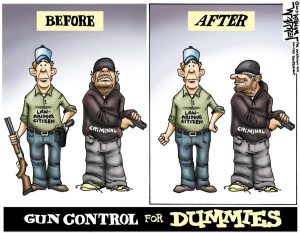
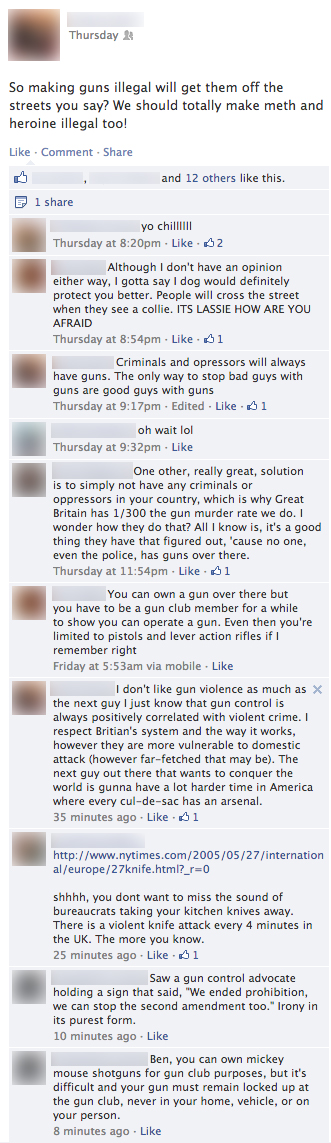
Since the connecticut incident my friends on facebook have been sharing their opinions Some blame mental illness in the health system, others place it on gun policy, and some say that it’s one incident and nothing should change. This was one of the most recent post and conversations. I’ve found that on facebook people generally try not to disagree, if you agree people like it and continue to agree within commentary. Unless of course it’s anonymous.
 design, place & social innovation studio